Better for broad participation
Stations let you vary demand, pace, roles, and scoring across a larger crowd.
 WhatsApp
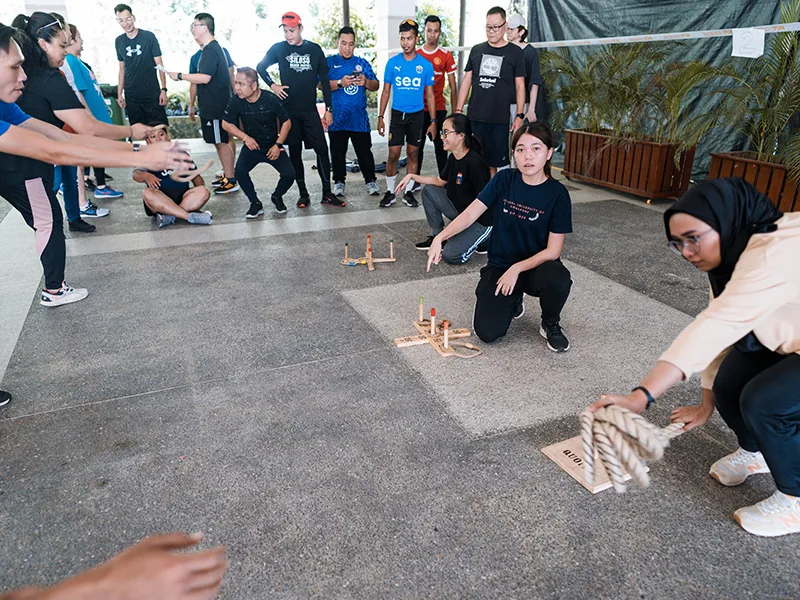
Activity comparison
Telematch is stronger when the group is larger, more mixed, or needs station-based participation. Dodgeball is stronger when the team wants a familiar active game and direct court competition is acceptable.
Start here
Choose group size, energy, and venue plan. The recommendation balances station flow against direct court-game energy.
Decision framework
Telematch is a planning system. Dodgeball is a focused game. The right answer depends on how much range the crowd needs.
Stations let you vary demand, pace, roles, and scoring across a larger crowd.
A familiar game can be efficient when the group is game-ready and the court setup is clean.
For large mixed groups, a single direct game can create waiting, exclusion, or comfort risk.
Side by side
Use this table when your approvers are deciding between station rotations and one familiar court game.
| Decision point | Telematch | Dodgeball |
|---|---|---|
| Best for | Large, mixed, or cross-department groups needing varied stations. | Game-ready teams wanting fast and familiar competition. |
| Group-size fit | Stronger from 60 people upward and scalable for very large groups. | Stronger for smaller court groups or as one station. |
| Inclusion floor | Higher because stations can vary physical demand. | Lower if direct targeting or elimination makes some people cautious. |
| Operational question | How many stations and facilitators keep teams moving? | How do eliminated players stay included? |
Planning pattern
Use proof when the comparison turns on whether one court game can carry the group.
Shows how clan flow and station timing support very large groups.
Large group 500 peopleShows how multiple play units can protect crowd flow.
Guide 50+Connects station proof to 50, 100, and 200 people planning.
Useful next steps
Use these pages when you are ready to compare formats, check details, review examples, or contact Cohesion.
Use these routes when group size is the main decision driver.
Readiness check
Use this before choosing the simpler-looking activity.
Brief builder
Capture the scale and comfort trade-off clearly.
Proof and context
Use these routes when group size and participation floor are driving the comparison.
FAQ
Use the Event Planner once you know approximate headcount, date range, venue direction, and the decision that is still open. The planner preserves this page context so Cohesion can respond with a sharper recommendation.
For simple office groups, a shortlist can come first. For larger, weather-sensitive, or multi-zone events, venue fit and activity fit should move together.
No. This page helps you decide the direction. The activity pages still explain the actual format, game modes, setup, and request path.
Next step
Use the planner if you already know the rough date, group size, and event direction.
Open Event Planner