Variety protects participation
Different station types let more people contribute through speed, communication, coordination, balance, and encouragement.

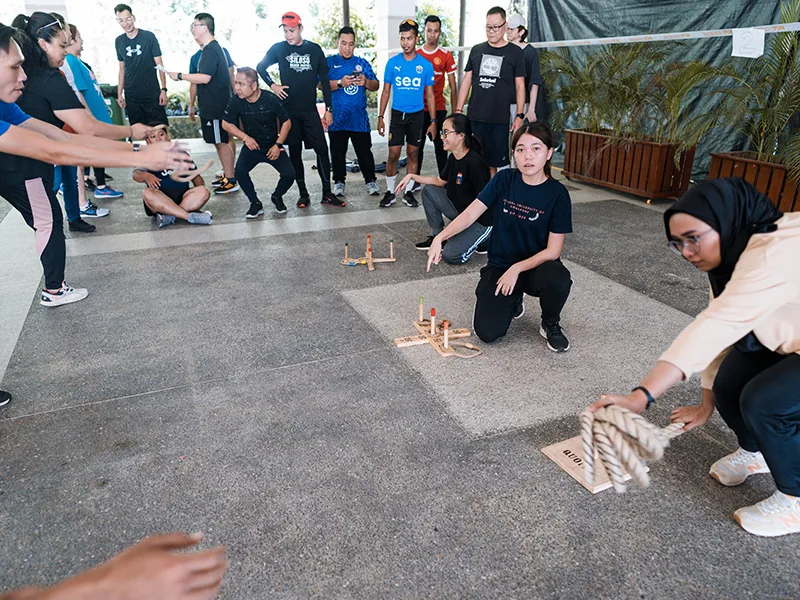
Telematch planning guide
Telematch is strongest when a company needs broad participation, varied energy, and facilitator-led pacing. It is often safer than a single intense game for large or mixed groups because stations, scoring, and rotations can be tuned around the crowd.
Start here
Choose the group profile. The result explains whether Telematch should be the anchor activity, a low-barrier participation format, or part of a wider event layout.
Decision framework
The value comes from how stations, teams, scoring, and facilitators keep the group moving. Treat those as the core design choices.
Different station types let more people contribute through speed, communication, coordination, balance, and encouragement.
Scoreboards, team names, and a final reveal help a large group feel like one shared event.
Clear briefings, reset timing, and station ownership prevent the activity from feeling messy as people grows.
Side by side
Use this when your approvers are choosing between broad participation and a sharper one-game experience.
| Decision point | Telematch | Single-game format |
|---|---|---|
| Best when | The group is large, mixed, or needs varied participation. | The group clearly wants one immersive game loop. |
| people logic | Stations and teams can scale the format upward. | Waves and waiting areas must be managed carefully. |
| Comfort floor | Easier to include different energy and fitness levels. | Can be stronger for game-ready teams but riskier for mixed groups. |
| Main planning risk | Station count, facilitator coverage, and scoring clarity. | Queue time, venue fit, and uneven participation. |
Planning pattern
These proof routes show why Telematch is usually discussed as an operating model for scale, not only as a fun activity name.
Useful reference for clan rotation, station pacing, and large-group scoreboard logic.
Multi-format scale 500 peopleShows when a bigger event needs multiple activity zones instead of one stretched game.
Repeat proof DBSShows Telematch appearing alongside Laser Tag, Archery Tag, and Bubble Soccer for different group profiles.
Useful next steps
Use these pages when you are ready to compare formats, check details, review examples, or contact Cohesion.
These are the most useful supporting pages for this decision.
Readiness check
Tick what is known before treating Telematch as ready to quote.
Brief builder
Capture the rotation assumptions so Cohesion can recommend station count and pacing quickly.
Proof and context
Use these when the internal decision needs confidence around scale, mixed participation, or alternatives.
Review the main Telematch activity page and request path.
360 people proof TADM Telematch case studyLarge-group Telematch reference for station flow and clan-style rotations.
Planning tool Large Group SelectorCompare Telematch against Laser Tag, Bubble Soccer, and multi-format station plans.
FAQ
Use the Event Planner once you know approximate headcount, date range, venue direction, and the decision that is still open. The planner preserves this page context so Cohesion can respond with a sharper recommendation.
For simple office groups, a shortlist can come first. For larger, weather-sensitive, or multi-zone events, venue fit and activity fit should move together.
No. This page helps you decide the direction. The activity pages still explain the actual format, game modes, setup, and request path.
Next step
Use the planner if you already know the rough date, group size, and event direction.
Open Event Planner