Plan
Use a clan-based Telematch rotation with one central timing and scoring path.
 WhatsApp
A large Telematch is not just a bigger set of games. The useful pattern is the control system: clans, arenas, team units, timing, scoring, movement, and one visible event rhythm.
Based on a past Cohesion Telematch event.
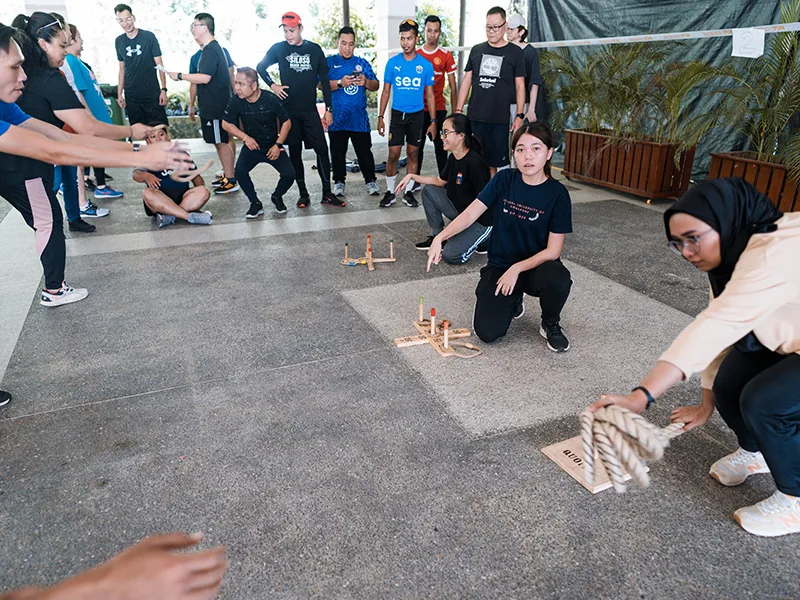
Use this snapshot to review the client, group size, venue, arena plan, and team structure before adapting a similar large-group Telematch.
| Client | Tripartite Alliance for Dispute Management |
|---|---|
| Short name used here | TADM |
| Event date | 6 March 2023 |
| Group size | 360 participants |
| Venue | MOM Services Centre, 1500 Bendemeer Road |
| Format | Telematch |
| Arena plan | 6 arenas |
| Clan structure | 5 clans |
| Team unit | Each arena split into 5 teams of 12 |
| Planning reference | Past Cohesion Telematch event |
Use this planner to turn the example into a starting brief. Share your date, venue, weather exposure, food plans, approvals, facilitator needs, budget, and event timing so Cohesion can shape the format around the real event.
Recommended direction
Use a clan-based Telematch rotation with one central timing and scoring path.
Send the rotation assumptions into the Event Planner so Cohesion can check venue footprint, timing, and facilitator coverage.
Use this pattern when the brief is large, mixed, and rotation-led. The exact arena count still depends on venue, timing, facilitators, weather plan, food, and approvals.
The clan is the scoreboard identity. It helps a 360-person event feel like one shared programme instead of six separate corners.
Teams of 12 per arena are easier to brief, move, and score than one large crowd waiting around each game.
Large Telematch days need a single timing rhythm and a clear score path from each arena back to the main result.
The format is only as strong as the movement plan between briefing, arenas, water breaks, food, and closing.
This case study is useful as a planning reference. The right activity mix still depends on your group size, venue, timing, weather plan, and how active your team wants to be.
| Keep | Adjust | Reason |
|---|---|---|
| Clan-based scoring | Publicly tracking every micro-result | A clan result is easier to explain at 360 people. |
| Pre-assigned teams | Sorting everyone on event day | Late team sorting can consume the schedule before games start. |
| One rotation rhythm | Each arena deciding its own timing | Independent timing creates crowding and uneven waiting time. |
| Facilitator control points | Free-flow movement between arenas | Large groups need clear movement ownership. |
Start from the useful structure, then tune the activity mix around your current team. A repeatable event is not about copying every detail; it is about keeping the pacing, briefing, and movement clean for the group in front of you.
Use these guides if you are still deciding on activity fit, headcount, budget, venue, weather plan, quote details, participation comfort, or event-day timing.
It shows a 360-person Telematch structure using 6 arenas, 5 clans, and smaller team units so scoring and movement could be managed at scale.
Use the 6-arena structure as a starting reference, then tune the arena count around venue footprint, game selection, timing, facilitator coverage, weather plan, and the wider schedule.
Clans give participants a simple shared identity and make the closing score easier to understand than a long list of individual station results.
Check venue space, holding areas, facilitator coverage, movement routes, weather branch, food timing, and how scores will be tabulated.
Share the group-size forecast, venue layout, available time, preferred energy level, food timing, weather exposure, and whether teams or clans can be assigned before event day.
Use this case study as a starting point. Your event still needs its own fit check around people, space, activity intensity, weather, food, movement, and approvals.