Sweet spot is 20-100, tightest at 30-60
Three to six teams of 6-10 rotate through seven stations in 90 minutes. Below 15 the rotation gets thin; above 100 the room and pacing pressure rises.

Activity support guide
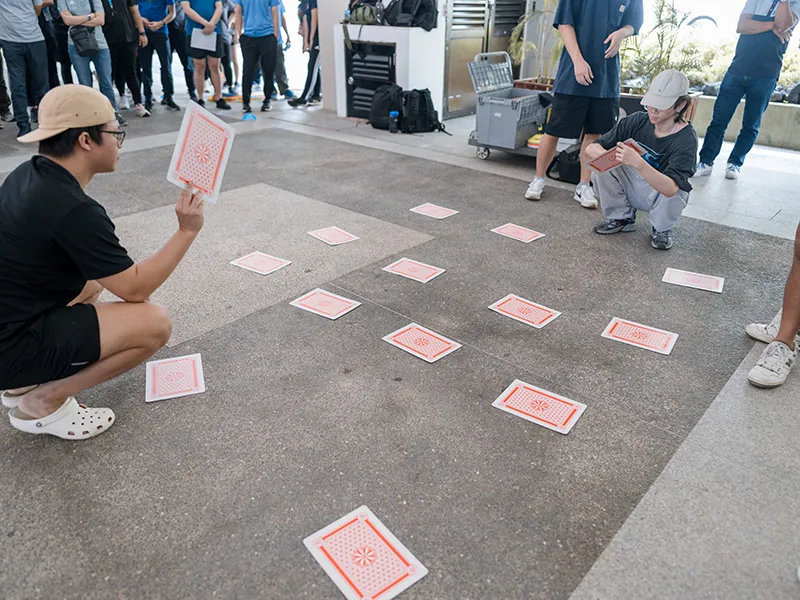
The 60-Second Corporate Challenge is seven one-minute mini-game stations with team rotation, scoring, and a hosted close — a complete event in two to three hours. The format suits 20-100 people in a function room or office floor; stations are deliberately varied so no single skill dominates the scoreboard.
Start here
Choose the event shape. The recommendation explains whether the Challenge fits as a headline activity, as part of a wider day, or whether a broader station format suits the scale.
Decision framework
The format is easy to brief and easy to run. The event runs better when you maps people, venue, and pacing before treating it as confirmed.
Three to six teams of 6-10 rotate through seven stations in 90 minutes. Below 15 the rotation gets thin; above 100 the room and pacing pressure rises.
8-10 sqm per station plus walking lanes; table surfaces for some stations; no sports venue, specialist equipment, or weather contingency required.
Stations are deliberately varied (aim, memory, balance, timing, communication) so no single skill dominates. Quieter participants find one or two stations they carry.
Group-size picker
The format scales, but the rotation logic and team structure change with the group-size band. Use this matrix to size the setup before locking the brief.
| Group size | Team and rotation setup | Why it works |
|---|---|---|
| 20-30 people | Three teams of 6-10; two rotations through each station | Repeats give every team multiple shots at each challenge; fills the 2-3 hour window without thin moments. |
| 40-60 people | Five to six teams of 8-10; single full rotation through seven stations | Cleanest single-rotation fit; pacing is tight enough to keep energy up without over-running. |
| 60-100 people | Duplicate stations or run two parallel waves | Avoids station bottlenecks; preserves the 60-second pacing rhythm at the upper edge of single-room fit. |
| Below 15 people | Format does not fit cleanly — pick a smaller hosted activity | Rotation logic gets thin; the team is better served by a single shared experience like Bubble Soccer. |
| Above 200 people | Switch to Telematch or a designed-for-scale rotation | Pacing dominates the day at that scale; Telematch handles the production weight and theatre better. |
What it feels like
A walk-through of a typical 60-Second Corporate Challenge event, so you can pre-empt the energy curve before the day runs.
Light energy, name tags, casual conversation. The room does not look like a sports event.
Facilitators explain the rotation in two minutes. Teams form. Everyone knows what they are doing in three.
Initial nerves at the first station. By the second station, the team has settled into the rhythm. Each station is short enough that nobody is exposed for long.
Competitive but not high-stakes. Scores swing back and forth. Quieter team members usually find one or two stations they are particularly good at.
Energy peaks. Teams are tracking the scoreboard mentally. Side competitions emerge naturally.
A short hosted moment. Winning team is named; everyone clears up together.
People stay around the room for ten or fifteen minutes. The event ends without an unclear 'is this over?' moment.
Useful next steps
Use these pages when you are ready to compare formats, check details, review examples, or contact Cohesion.
These are the most useful supporting pages for this decision.
Readiness check
Tick the expectation points before treating the Challenge as ready to quote.
Brief generator
Create a short note so Cohesion can confirm group-size fit, venue setup, and where the Challenge sits in the wider event flow.
Proof and context
Use these routes to firm the brief and check the format against alternatives.
Review the format, station kits, and request path.
Comparison Telematch at scaleUse this when the group-size band is approaching 100+ and you are weighing the Challenge against a larger station rotation.
Planning guide Mixed Group FitCheck the broader skill-mix inclusion angle before locking the format.
FAQ
The format is in that family, but the corporate version uses scoring rules and team rotation logic that make it work for a structured corporate event rather than a casual party.
The stations are deliberately low-impact. Most participants can stand, sit, or step in and out of any station comfortably. Quieter participants often choose the memory or communication stations and quietly carry their team there.
Yes — that is one of the format's main advantages. A function room, large meeting room, or open office floor is usually enough. Cohesion brings the station kits.
Yes. The most common pattern is light bites or a buffet at the end. Food should be scheduled before or after the rotation, not during it.
Different format families. The Challenge is tighter, office-friendly, and lower production weight; Telematch is hosted-station-rotation at larger scale with broader event-day feel. For 30-80 people in a function room, the Challenge usually fits better; for 80+ in an event venue, Telematch usually fits better.
Next step
Use the planner if you already know the rough date, group size, and event direction.
Open Event Planner